"Why ClearChoice Closes 25% More Cases Than Your Practice (And How to Catch Up)"

ClearChoice Dental Implant Centers stands as one of the leading dental implant clinic networks in the United States, renowned for its advanced marketing strategies and lead management practices. Let's examine how ClearChoice (and similar sophisticated networks) systematically process leads: from initial inquiry through consultation scheduling to the actual implant procedure. We'll pay particular attention to what data is collected in their CRM, how it's enriched and segmented, and why this matters at each stage.
Funnel Overview: From Lead to Consultation to Surgery
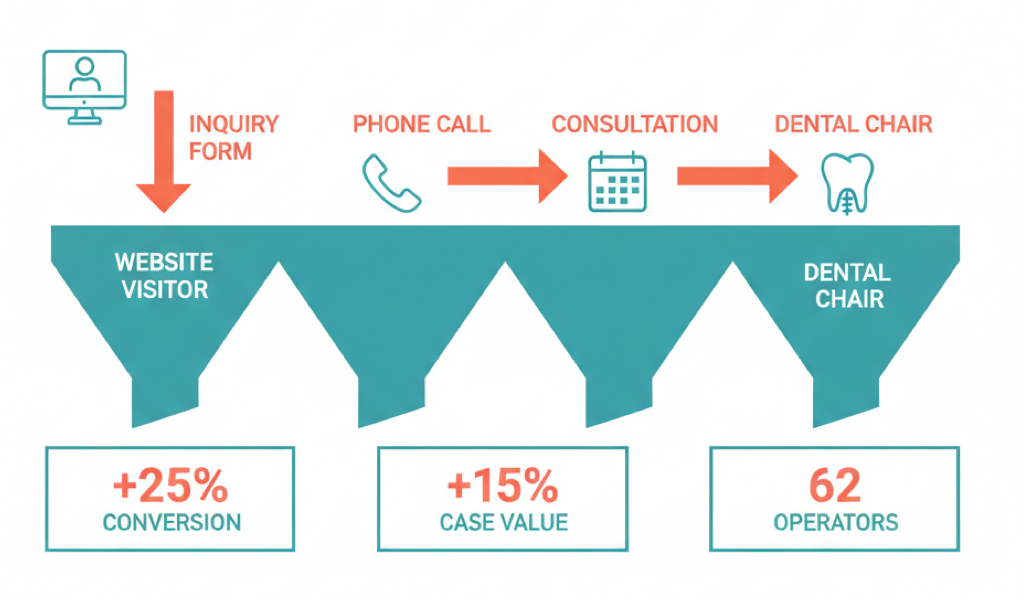
The patient journey at ClearChoice begins with marketing. After launching advertising campaigns, potential patients visit the website and submit an inquiry (online form) or call the contact center to schedule a free consultation. All inquiries flow into ClearChoice's centralized contact center, where a team of trained agents processes each case. Patients schedule consultations by connecting with ClearChoice's Denver-based call center, where specialists answer their questions and address concerns about implant procedures. This personalized approach from first contact is crucial, as many patients experience anxiety about the procedure or implant costs.
Contact center agents then schedule the patient's visit to the nearest ClearChoice center (the company operates dozens of centers nationwide). During the consultation, an examination is conducted (including 3D CT scanning when necessary) and the treatment plan is discussed. The goal is to convert the lead into a patient—convincing them to begin the implant procedure. This entire funnel—from lead to consultation to surgery—is carefully tracked and optimized within the CRM system.
Initial Data Collection and CRM Entry
At the first stage—when a lead comes in—ClearChoice captures baseline data in their CRM. For web inquiries, patients fill out a form with contact information (name, phone, email) and typically provide their city/zip code (for routing to the nearest clinic). Additional fields may include how they heard about the clinic or which specific service interests them.
Modern AI widgets, such as smart calculators on platforms like dentalprice.ai, enable collection of much more data during the initial website interaction. While visitors calculate procedure costs, the system can automatically identify:
- Procedure type of interest (All-on-4, single implant, full restoration)
- Patient's budget assessment
- Financing needs and credit score range
- Insurance coverage confirmation
- Geographic location
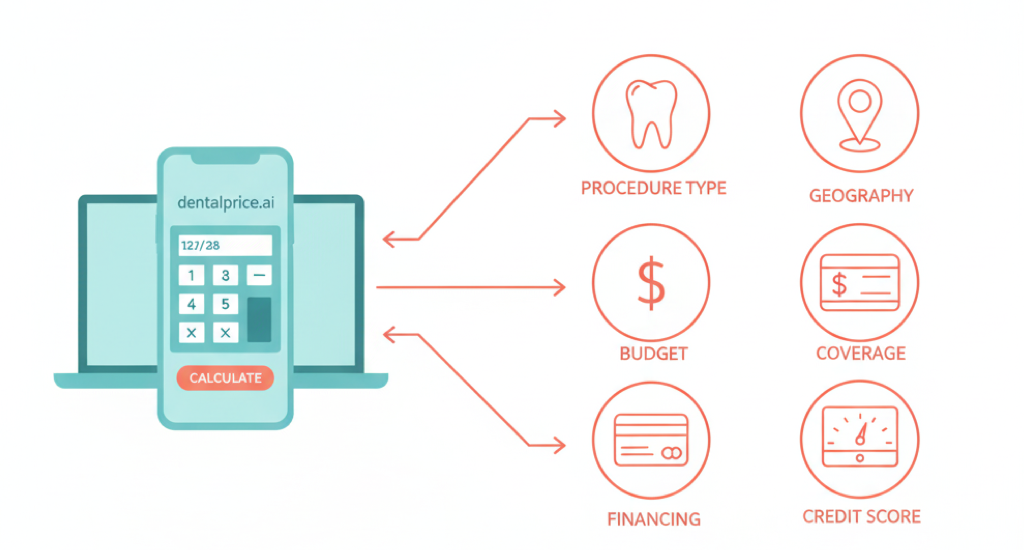
This data flows directly into the CRM with preliminary lead qualification, giving smaller clinics and regional networks a competitive advantage comparable to large corporations.
All this information flows into ClearChoice's CRM (Customer Relationship Management system) for further processing.
Note: ClearChoice uses Salesforce as their primary CRM for managing patient contacts.
Phone Inquiries and Call Center Operations
When leads call by phone, contact center agents manually enter their data into the CRM. During the conversation, the agent gathers key information: the patient's primary concern, any contraindications, their level of interest, etc. For example, if someone calls asking about full mouth implant restoration, the agent will note this. ClearChoice's call center consists of approximately 62 operators handling inbound and outbound calls, primarily focused on appointment scheduling and confirmation.
For clinics lacking resources for such an extensive call center, there's an alternative: AI voice assistant systems (integrated with platforms like dentalprice.ai) can automate initial outreach and lead qualification. The voice assistant conducts preliminary conversations, answers basic questions, and transfers only "hot," qualified leads to live coordinators. This allows smaller practices to compete on efficiency with large networks while optimizing staff time utilization.
Thus, every incoming lead immediately receives a CRM record with contact details, referral source, and preliminary information about their needs.
Why Collect This Data?
First and foremost, to ensure no one falls through the cracks: CRM enables tracking of every lead and ensures no follow-up touchpoints are missed (calls, emails).
- Contact details → needed for subsequent outreach and email campaigns
- Location or center selection → to schedule consultations at the right clinic
- Inquiry or interest information → to personalize communication (for example, sending relevant materials)
Even at this stage, basic segmentation can begin—for instance, dividing leads by acquisition channel (website, advertising, phone, etc.) or geography (center regions). These fields are often automatically attached to the lead in CRM when the inquiry is created.
Lead Enrichment at the Initial Stage
After entering baseline information, ClearChoice and other advanced organizations often apply lead data enrichment. Lead enrichment is the process of supplementing a lead's profile with additional information from internal or external sources. Simply put, the system "enhances the dossier" on each potential patient to build the most complete portrait possible. This is done within reasonable limits and with privacy compliance, but delivers significant value.
What Data Can Be Enriched?
For example, the system can automatically:
- Refine lead geography (by zip code—nearest center, region)
- Pull demographic data (age range if available; gender if not explicitly stated)
- Track previous interactions (if this person previously visited the site, requested a brochure, etc.)
In B2B, enrichment often includes company and position data, but in healthcare the focus is on contact and behavioral data.
Behavioral Data Collection
You can track which website pages the lead visited, whether they downloaded an e-book or watched patient success story videos. AI calculators collect particularly valuable behavioral data:
- How much time the user spent in the calculator
- Which options they considered
- Whether they adjusted their budget
- Whether they explored alternative procedure options
These behavioral markers are immediately recorded in the patient profile and provide clear insight into the seriousness of their intent.
The Goal of Enrichment
Data completeness directly impacts sales effectiveness: the more relevant information available, the easier it is to identify which leads are most likely to become patients and focus on them.
For example, if data shows that someone actively studied the implant cost section and downloaded a "How Implantation Works" guide, that's a "hot" lead deserving special attention.
Additionally, enrichment eliminates basic obstacles: phone numbers and emails are verified (to avoid errors), gaps are filled. Ultimately, sales staff save time on gathering basic information and can personalize offers for each lead based on their profile.
Lead and Contact Segmentation in CRM
Once lead data is collected and enriched, segmentation begins—dividing leads into groups based on specific criteria. At ClearChoice, segmentation is a key element of CRM strategy, enabling a customized approach to different patient categories.
According to descriptions of Aspen Dental's (ClearChoice's parent company) CRM initiatives, one priority task is "advanced segmentation" of the audience. This means leads are divided into segments not just by one characteristic, but by combinations of data, using automated rules and even predictive models.
What Parameters Are Used for Lead Segmentation?
1. Funnel Status
One basic method is segmentation by stages. For example:
- New leads
- Leads scheduled for consultation
- Consultation completed
- Decision pending
- Surgery scheduled
CRM automatically moves contacts from segment to segment as they progress through the funnel (for instance, after attending a consultation, the status changes). This helps the team focus: new leads receive one type of attention, those who are hesitant after consultation receive another, and so on.
2. Lead Quality and Readiness
ClearChoice, as a company offering high-value services, seeks to qualify leads by quality. This involves lead scoring—assigning points based on criteria matching:
- Age 40-70 might earn more points than age 18
- Multiple missing teeth noted in the questionnaire
- High interest demonstrated on the website
Smart forms and AI widgets (dentalprice.ai) automate this process, assigning scores to leads during their calculator interaction: if a user indicates a realistic budget for All-on-4, confirms financing readiness, and spends more than 3 minutes exploring options in the calculator—that's automatically a high score. The system immediately flags such leads as priority for immediate follow-up.
Based on total scores, leads can be segmented into:
- "High-priority" (highly likely to become patients)
- "Low-priority" (require more nurturing)
This enables efficient distribution of sales team efforts. Quality lead data = proper segmentation and focus on the most promising prospects, personalized approach, which ultimately leads to more closed cases.
3. Source and Acquisition Campaign
Leads are also grouped by acquisition channels. This matters because patients from different channels may differ in profile and behavior:
- Leads from Google search ads who saw a specific discount offer
- Leads from Facebook who watched a patient testimonial video
- Leads from referral programs
In one dental case study, separate lead forms were created for each advertising audience, and CRM segments were tagged by creative/targeting audience source. This allowed analysts to track conversion to appointments for each audience segment and concentrate budget on the most effective segments.
Thus, source-based segmentation not only changes the approach to patients but also improves marketing ROI.
4. Geography and Clinic
Since ClearChoice is a nationwide network, leads are immediately assigned to a specific market/center segment (by ZIP code). This is necessary to route leads to the appropriate local coordinator team.
Additionally, there are approach variations:
- In large cities where competition is higher → leads need faster processing
- In some areas → emphasis is on financing programs
Regional segmentation allows for these nuances.
5. Patient Interests or Needs
If a lead's need can be determined (say, wants an implant for one tooth vs. full arch restoration), they're segmented accordingly:
- "Single tooth" case → different communication approach
- "Full-arch case" → discussing All-on-4, complete restoration options
The agent notes this in CRM, and the contact is then tagged accordingly. This affects the content of emails and conversations in subsequent contact.
6. Financial Profile
In private-pay medicine, segmentation by affordability is sometimes applied. Without direct access to patient finances, ClearChoice can segment indirectly:
- Interest in payment plans/credit financing
- Ready to pay upfront
- Veteran or senior status (special discounts)
AI calculators make this segmentation even more precise: they can determine not only financing interest but also approximate credit score, insurance type (PPO, HMO, DHMO), allowing immediate routing to the right financial coordinator with prepared options.
Multidimensional Segmentation
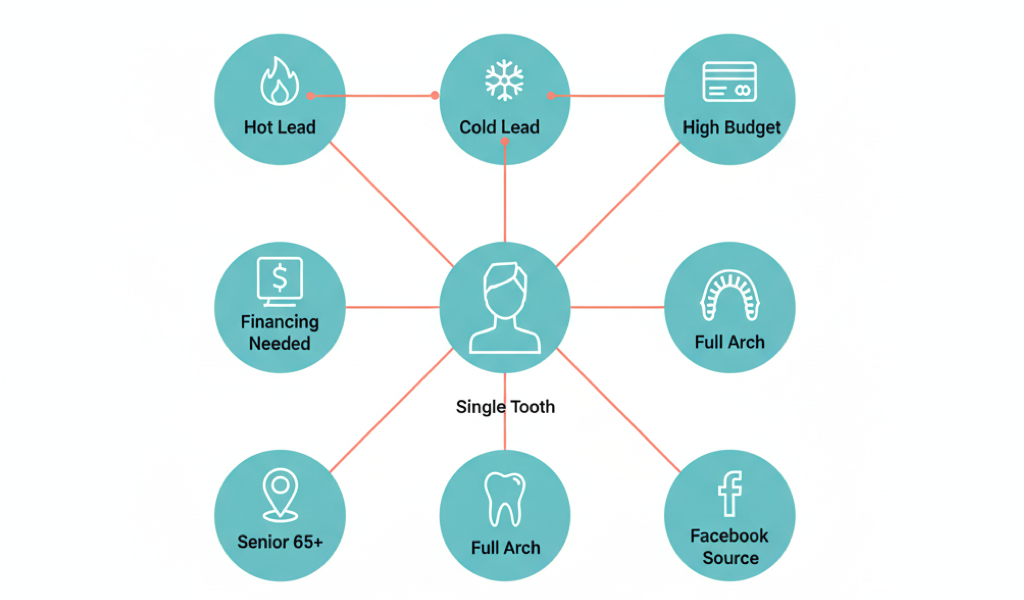
Importantly, segmentation isn't limited to one dimension. Advanced CRMs use multidimensional segmentation: combinations of different criteria.
For example, a lead might simultaneously be in:
- "Hot lead, score > 80"
- "Source: Facebook testimonial video"
- "Region: California (San Francisco center)"
This provides a 360-degree view. Segments are used both for organizing the sales process (lead distribution to managers, priority setting) and for launching targeted marketing activities:
- Email campaign #1 → only to those who didn't show for a consultation after 1 week of waiting ("no-show" segment)
- Email campaign #2 → only to those who indicated credit interest
- SMS campaign → only to high-score leads within 24 hours of inquiry
Personalized Approach (Nurturing) to Each Segment
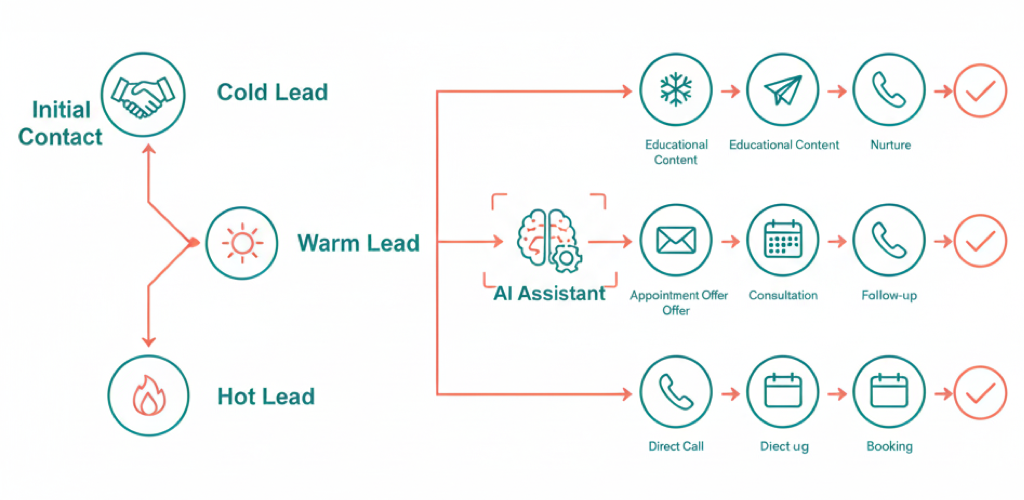
After segmentation, ClearChoice applies "nurturing" strategies—bringing leads to readiness to schedule and undergo treatment—tailored to their segment. In other words, different lead groups are worked differently, with maximum targeting. This custom approach manifests both in operator work and in the content of materials sent.
At the Call Center Level
Agents are trained to adapt conversations to patients:
For "cold" leads (who just submitted an inquiry out of curiosity, didn't answer calls):
- More explanation of implantation value
- Offering free consultation
- Educational approach
For "warm" leads (who actively inquired themselves, called immediately):
- Focus on answering specific questions
- Addressing fears directly
- Quickly scheduling a convenient visit time
ClearChoice is known for not limiting operators on call duration: agents are allowed to spend as much time as needed to answer all potential patient questions. This approach builds trust and satisfaction from first contact, which is critically important when selling complex medical services.
For smaller-scale clinics, AI voice assistants can handle initial processing of "cold" and "warm" leads through different scenarios, transferring only qualified inquiries to coordinators with full conversation context. This allows smaller practices to achieve the same level of personalization as large corporations, but with minimal staff.
Content and Lead Warming
ClearChoice extensively applies content marketing to "warm up" interest. After first contact, leads may begin receiving materials appropriate to their segment and stage:
Those who are hesitant or fearful receive:
- Success stories from other patients
- Testimonial videos
- E-books/guides answering common questions about implantation
- Before/after photos and case studies
These materials demonstrate ClearChoice's expertise and real results, helping dispel fears and build trust.
Leads concerned about price receive:
- Information about financing options
- Free consultation details
- Free 3D CT scanning offer
Incidentally, providing free consultation and CT scan to all leads is a deliberate ClearChoice strategy: it lowers the entry barrier and allows the clinic to immediately assess patient suitability for implantation. For patients, the free scan is a valuable bonus; for ClearChoice, it's a way to qualify the lead (understand if there's sufficient bone tissue, how complex the case is).
Actively interested leads may:
- Be invited to register for a webinar with a doctor
- Receive a personal letter from the clinic's surgeon to establish personal contact
Journey Orchestration
Essentially, each segment receives its own set of touchpoints and messages at the right moment. This "journey orchestration" is also a priority task for CRM specialists.
Automated scenarios include:
- If a lead didn't answer phone calls → automatic email: "We tried calling you, here are patient stories to read, and the consultation is still free—come in."
- Those who scheduled a consultation but haven't come in → reminder: "Don't delay your decision, here's a coupon for X% discount, valid through month end."
These scenarios are planned and automated in CRM and marketing automation systems.
The Results
Communication personalization increases conversion chances. According to ClearChoice data, this quality approach to leads delivered tangible results:
- ✅ 25% increase in patient conversion rate
- ✅ 15% increase in average case value
Conversion growth confirms: if you guide leads through the funnel attentively, addressing their needs and concerns specifically, they convert to surgery significantly more often.
Systems and Technical Aspects Used
Technically, ClearChoice implements its systematic approach on modern cloud solutions. As noted, the primary CRM is Salesforce (one of the top customer management solutions). Layered on the CRM are contact center tools (NICE CXone—a cloud contact center platform).
Salesforce integration with telephony enables each operator to work from a unified interface: the lead's CRM card pops up right when the call comes in. According to the contact center manager:
"CXone Agent for Salesforce is the best agent console we've ever used. The interface is very convenient and flexible."
All interaction history (calls, emails, meetings) is logged in CRM, providing a single source of lead data.
Enterprise-Level Technology Stack
Additionally, the Aspen Dental group of companies (including ClearChoice) uses:
- Modern customer data platforms (CDP) - Salesforce Data Cloud
- Marketing automation tools
- Personalization and analytics platforms
This indicates that lead behavioral data (online activity, email responses, ad reactions) flows into a unified base and is used for automatic segmentation and trigger campaigns.
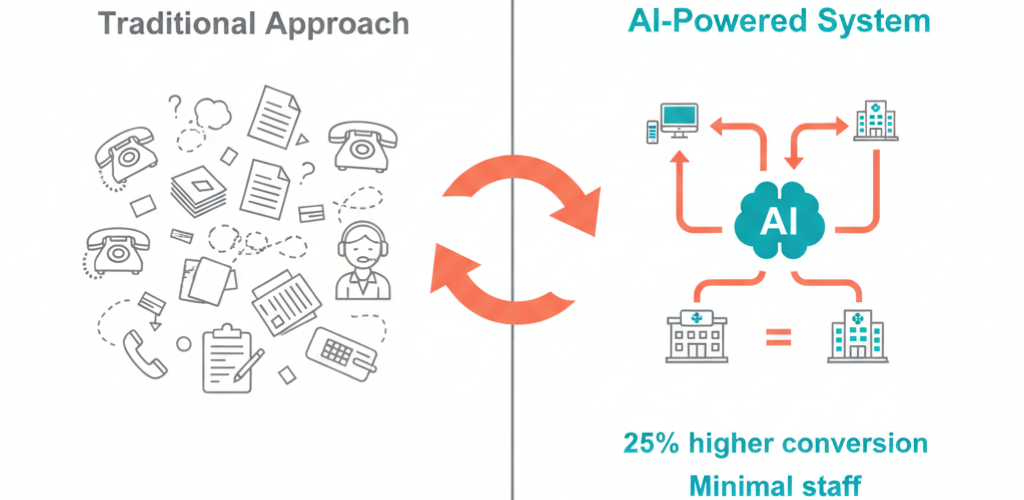
Solutions for Smaller Clinics
Show Image
For smaller clinics, more compact solutions with similar logic are available. Modern AI widgets (such as dentalprice.ai) integrate with popular CRM systems and automatically transfer qualified leads with complete data sets for segmentation.
Combined with AI voice assistant for outreach, a small clinic or regional network can build a funnel that competes on efficiency with large corporations—but with minimal infrastructure and personnel investment.
Automation Benefits
Despite the complex technology stack, technical details are hidden "under the hood"—for marketing and sales managers, everything looks like a unified CRM process. An important technical aspect is automation: many routine tasks happen without human intervention through predefined rules:
- Lead routing to the right manager
- Sending emails after 1 day
- Consultation reminders 24 hours in advance
- Follow-up sequences based on behavior
This ensures no lead gets "stuck" without attention and everyone receives the right touchpoint at the right time.
Scalability and Quality Control
Systems also enable scalability and quality control. For example, ClearChoice implemented intelligent scheduling and operator workload management: thanks to the Workforce Management module in CXone, they precisely plan how many people are needed on phones during peak hours and achieved near-elimination of call forwarding to external call centers (outsourcing).
This improved both economics and communication quality, as leads now more often reach in-house agents well-versed in clinic services.
Conclusions and Key Results
Lead segmentation and personalized work with them is a key element of ClearChoice's success. After receiving a lead, the company immediately:
- Captures all data in CRM
- Enriches the profile with needed information
- Assigns the contact to specific segments
This allows adapting subsequent steps to the patient: whether it's a lengthy explanatory conversation by an operator without rushing, sending targeted materials, or special offers. Technically, the process is supported by a powerful CRM platform (Salesforce) and integrated call center, while analysts constantly monitor funnel conversion across segments, adjusting strategy.
The Democratization of Advanced Lead Management
For other advanced clinic networks in the US, a similar approach is becoming standard. It's important to note that today, such efficiency is available not only to large corporations.
Thanks to modern AI tools such as:
- Smart calculators and intelligent appointment forms (dentalprice.ai)
- AI voice assistants for outreach
- Automated segmentation systems
Small clinics and regional networks can build competitive funnels with automatic segmentation and lead qualification. This democratizes access to advanced lead management practices and allows independent practices to effectively compete with major players.
The Bottom Line
Segmentation and CRM marketing enable clinics to transition from mass "conveyor belt" processing to personalized service, which is especially important in fields where treatment decisions require trust and time.
As ClearChoice's results show, investment in a systematic approach pays off:
- ✅ Increased consultation bookings
- ✅ More successfully completed surgeries
- ✅ Higher patient satisfaction
- ✅ Better ROI on marketing spend
This confirms a simple truth: the right message—to the right person—at the right time can significantly increase the effectiveness of any marketing funnel.
References & Sources Primary Case Studies
- NICE CXone Case Study: ClearChoice Dental Implant Centers
- Source: cdn.featuredcustomers.com
- Key findings: ClearChoice operates 62 inbound/outbound agents, uses Salesforce CRM integrated with NICE CXone platform
- Results: 3% increase in inbound calls, 23% increase in outbound calls, reduced outsourcing volume
- FasterCapital: CPQL Marketing - ClearChoice Case Study
- Source: fastercapital.com
- Key findings: ClearChoice implemented Cost Per Quality Lead (CPQL) marketing approach
- Results: 25% increase in conversion rate, 15% increase in average order value
- Strategy: Free consultation and 3D CT scan offerings, content marketing (ebooks, videos, testimonials)
Methodology & Best Practices
- Zapier: Lead Enrichment Guide to Data Hygiene
- Source: zapier.com
- Explains lead enrichment process and its impact on sales efficiency
- Key insight: Better lead data helps identify most promising contacts and enables personalization
- BeBee: Director, CRM Operations Job Description - Aspen Dental
- Source: us.bebee.com
- Reveals CRM strategy priorities: advanced segmentation, lead enrichment, journey orchestration
- Context: Aspen Dental is ClearChoice's parent company
- Rogatin.me: Customer Segmentation for Dental Clinics (Russian case study)
- Source: rogatin.me
- Demonstrates practical implementation: separate lead forms for each Facebook audience
- Method: Tracking conversion by audience segment to optimize ad spend
Implementation Details
- NICE Featured Customers: ClearChoice Implementation Details
- Source: cdn.featuredcustomers.com
- Contact center specifics: No average handle time limits for agents
- Philosophy: "Take however long is needed to answer a prospective patient's questions"
- Technology: CXone Agent for Salesforce integration praised as "best agent console"
Additional Resources for Implementation
- DentalPrice.ai - AI-powered calculator and smart forms for automated lead qualification and segmentation
- Salesforce CRM - Customer relationship management platform used by ClearChoice
- NICE CXone - Cloud contact center platform with workforce management capabilities
- Salesforce Data Cloud (CDP) - Customer data platform for unified patient data
**Key Metrics Referenced:**
- 62 contact center operators (ClearChoice)
- 25% conversion rate increase (CPQL implementation)
- 15% average case value increase
- 3% increase in inbound call handling
- 23% increase in outbound call capacity
Last updated: November 2025